
In tiger tracking, sound matters more than sight. A sudden hush. A frantic call. A broken pattern of movement. The forest communicates constantly—you just have to learn its language.
By Chandran Iyer
The forest does not announce itself.
It waits.
As our jeep rolled into Pench at dawn, wrapped in fog and the kind of cold that slips through jackets and settles into bones, it was clear this was not a place meant to impress on command. Pench Tiger Reserve does not perform. It reveals—slowly, on its own terms, often when you stop trying too hard.
That, perhaps, is its greatest lesson.
Since it was February, we did not expect the place to be cold in the morning. We forgot that this forest is situated at an altitude.
The journey began in Nagpur—the Orange Capital of Maharashtra—still buzzing from the energy of the Global Panorama Showcase (GPS), a B2B travel event that brought together destinations, hoteliers, and travel professionals from across India. After two days of conversations, cards exchanged, and panels attended, the real learning was about to begin—outside conference halls, beyond PowerPoint slides.
On the evening of January 30, we left Hotel Centre Point in Nagpur, heading away from traffic and timelines, towards forests that predate both. Saputara flashed past briefly, but it was the deeper Central Indian wilderness that began to pull us in.
Our destination was a FAM trip to Tathastu Resorts, known for locations near Satpura, Pench, Tadoba , Kanha and Bandhavgarh . It is founded by Managing Director. Mr. Anil Agarwala, a visionary entrepreneur in Central India, has a distinguished career of over 40 years. Known for his ‘attention to detail’ and ‘go-getter’ spirit, he has successfully ventured into handicrafts, mining, real estate, and hospitality.
By the time we reached Satpura late at night, the air had changed. It felt heavier with silence.
Satpura, meaning Seven Mountains, is an ancient range stretching nearly 900 kilometres across Maharashtra, Madhya Pradesh, and Chhattisgarh. These are not dramatic peaks but old, wise hills—eroded by time, layered with stories, and draped in sal and teak forests.
At Tathastu Satpura, the ambience was understated, almost intentionally so, allowing the forest to take centre stage. I stayed in a Haldu cottage, named after the tree whose pale bark and sturdy presence mirror the spirit of this landscape.
General Manager Mohsin Khan, who welcomed us that night, summed it up simply:
“People come here thinking luxury is about rooms. But real luxury is waking up without noise and sleeping without fear.”
Understanding the Language of Forests
The next morning, after breakfast, we walked the property—not as tourists ticking boxes, but as listeners. Satpura teaches patience. The trees stand tall, yet nothing here feels rushed. The forest floor is alive with movement invisible to hurried eyes: insects, fallen leaves decomposing, pugmarks half-hidden in dust.
By noon, we were back on the road—five hours to Pench.
Pench Tiger Reserve straddles Madhya Pradesh and Maharashtra, its forests immortalised by Rudyard Kipling’s The Jungle Book. Yet the real Pench is not literary nostalgia. It is raw, alert, and intensely alive.
As we reached Tathastu Pench in the evening, the temperature dropped sharply. The altitude made itself felt. Night safaris were planned, but the forest had other ideas.
At Dawn, the Forest Breathes
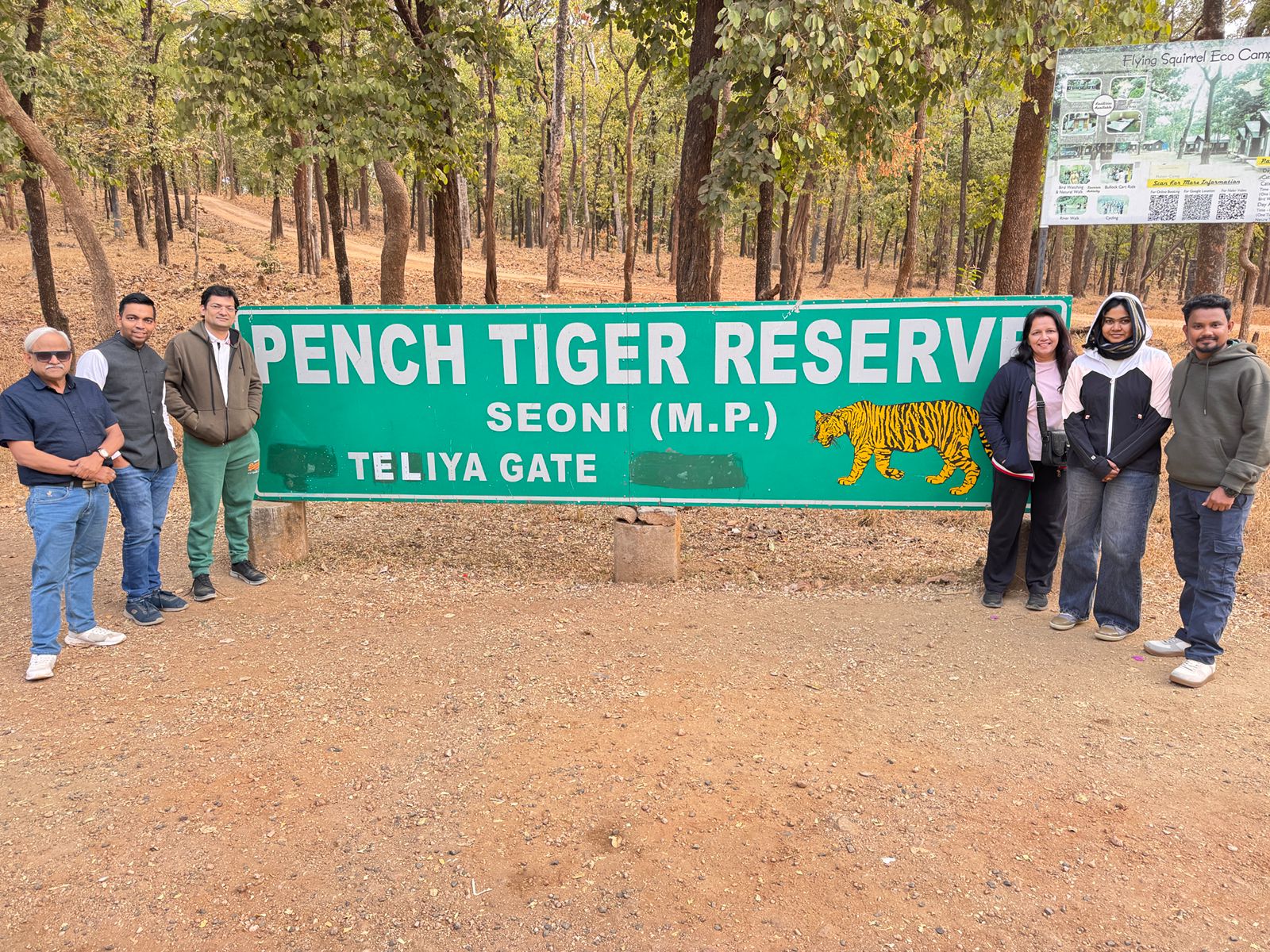
At the crack of dawn, wrapped in blankets provided by the resort—many of us having underestimated Central India’s winter—we entered Pench Tiger Reserve through the Teliya Gate, heading towards Seoni.
The jeep moved slowly, tyres crunching dry leaves. The forest was waking up.
Pench’s landscape is a mosaic—open meadows, dense teak forests, bamboo thickets, and seasonal streams. The Pench River snakes through the reserve, creating fertile grasslands that sustain a remarkable diversity of life.
Spotted deer grazed nervously, heads lifting in unison at the slightest sound. Sambar stood statuesque, ears rotating like radar dishes. Langurs leapt across branches, occasionally letting out alarm calls—sharp, urgent warnings that something powerful might be nearby.
We listened.
In tiger tracking, sound matters more than sight. A sudden hush. A frantic call. A broken pattern of movement. The forest communicates constantly—you just have to learn its language.
We scanned pugmarks etched into the mud—broad, confident imprints that spoke of recent passage. The tiger had been here. Just not for us.
When the Tiger Doesn’t Show Up
We didn’t see the tiger that morning.
There was a moment of collective disappointment. One of our companions, Amit Mathur, Director of Serenity Global Holidays, admitted quietly that he had hoped for that one iconic sighting.
But Pench has a way of correcting expectations.
Because suddenly, there it was—a leopard, draped casually across a rocky outcrop, as if the mountain itself had grown a heartbeat. Muscles relaxed. Eyes half-closed. Unbothered by our presence.
The mood changed instantly. Cameras clicked, but then fell silent. Some moments deserve to be absorbed, not documented.
Leopards in Pench are elusive, masters of camouflage. Spotting one is not consolation—it’s privilege.
And then there were the gaurs, the Indian bison—massive, dark, muscular, moving with surprising grace. Foxes darted across clearings. Wild boar rustled through undergrowth. Birds—drongos, bee-eaters, woodpeckers—added layers of sound.
The forest was full. Just not theatrical.
The Art of Conservation
Near the Khawasa Gate, Pench offers an unexpected sight: a 17-foot tiger statue, made entirely of scrap metal. It stands tall, powerful, constructed from what was once discarded.
Local artists, with support from forest officials, transformed waste into a symbol—an artistic reminder that conservation is not just about protecting animals, but reimagining human responsibility.
It’s also a reminder that Pench is evolving—finding new ways to speak to visitors without diluting its essence.
Life Beyond Sightings
Back at the resort, General Manager Jitendra Nonia offered perspective:
“Many guests come asking only one question—‘Will we see a tiger?’ But Pench is about more than sightings. It’s about slowing down and letting the forest change you.”
That change is subtle.
It’s in how you start noticing tracks instead of selfies.
In how silence becomes comfortable.
In how anticipation replaces impatience.
By the time we left Pench, it was no longer about what we hadn’t seen—but about everything we had felt.
From Pench to Tadoba: Carrying the Forest Within
Our journey continued to Tadoba in Maharashtra, another iconic tiger landscape. At Tathastu Tadoba, nestled amid dense canopies, the wilderness followed us indoors—through wood-themed spaces, soft lighting, and evenings filled with quiet conversation rather than noise.
General Manager Pramod Verma, a veteran hospitality professional with over three decades of experience, put it beautifully:
“Forests don’t offer entertainment. They offer perspective. And once you get that, you keep coming back.”
The Ending That Isn’t an Ending
We left without a tiger photograph.
But we returned with something rarer.
An understanding that the forest does not owe us sightings. That thrill lies as much in the chase as in the capture. That listening can be more rewarding than seeing.
Pench stays with you—not as an image, but as a feeling.
Of cold dawns and warm blankets.
Of alarm calls and silent trails.
Of a leopard resting on stone, unbothered by human ambition.
Some journeys give you stories.
Others quietly rewrite you.
Forest does the latter.