
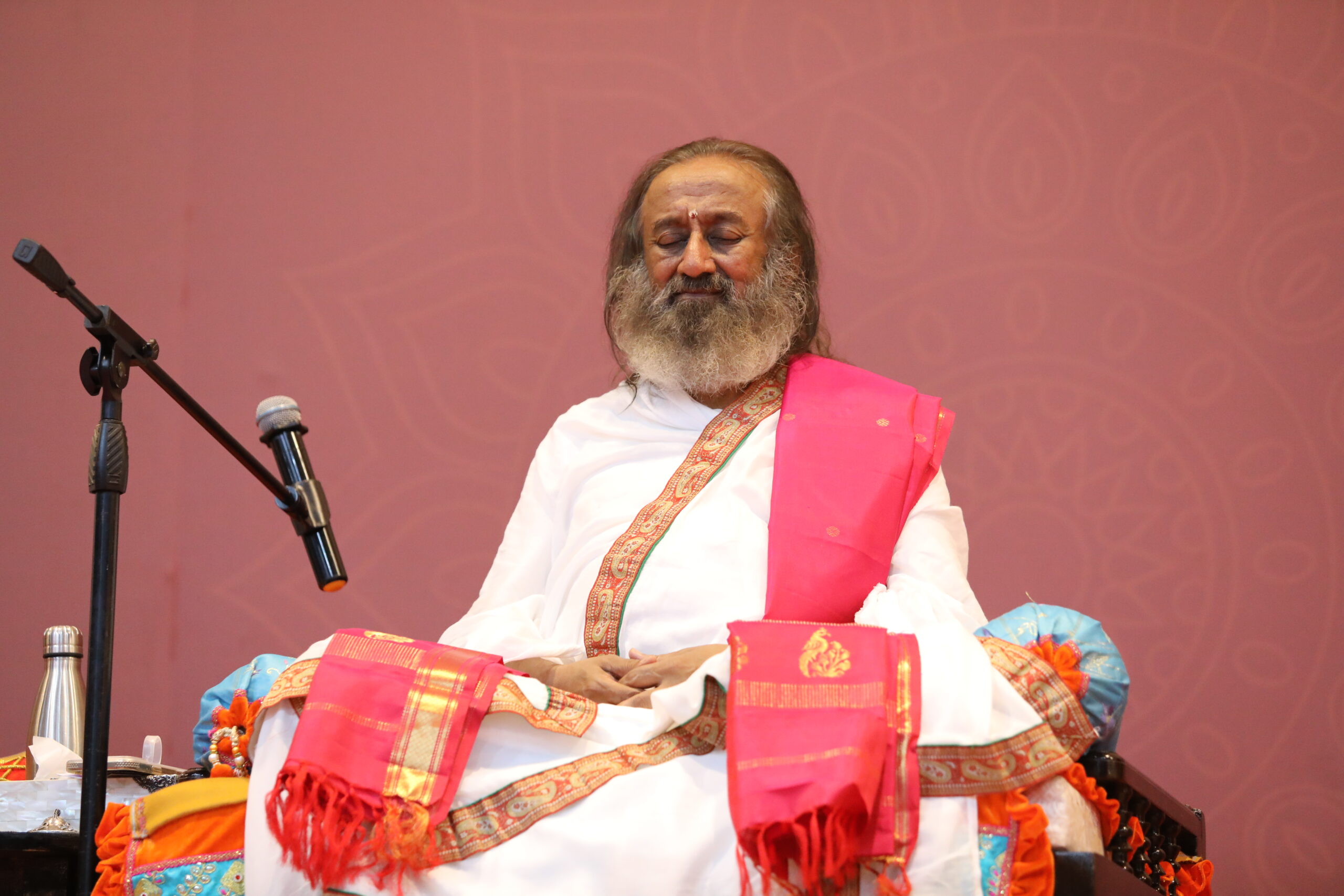
By Gurudev Sri Sri Ravi Shankar
Meditation is an art. Just as everyone has ten fingers and it is only a matter of learning how to use them to create something melodious with an instrument, similarly, as long as you have a mind with which you can think, you can meditate too. It is just that little skill to see how we can calm the mind and get in touch with the source of energy that you are.
When the mind becomes calm and centered, it gets access to this enormous intelligence and energy that resides within us. Meditation is a way to take that deep rest, and yet be alert and conscious.
Often, people complain that it’s very difficult to focus their minds and free themselves from thoughts, or it’s tough to relax. You don’t have to go to the Himalayas, you don’t have to become a recluse, change your lifestyle, or do a lot of penance to attain meditation. You can simply begin meditation with the right instructor who can help you calm the mind using a mantra using a sound. And then, in the very first sitting, you experience something so wonderful. Then, as you practice regularly, maybe once or twice a day, you notice a big transformation within yourself, and not only you but people around you will also start recognizing that beautiful energy that you carry around with you.
It is a natural tendency of human life to look for joy that doesn’t diminish, a love that doesn’t distort or turn into negative emotions like anger, hate, or jealousy. Meditation is absolute comfort (AC). Wanting comfort is natural because you have experienced that unmatched state of comfort in your mother’s womb. In your mother’s womb, you had to do nothing. Food was fed directly into your belly, and you were happily floating in the fluid, turning and kicking. That is meditation or absolute comfort.
Getting back to that serenity which is your original nature is meditation. Meditation is food for the soul. How can you have a good meditative experience? By doing a few things, you can prepare yourself for a good meditation.
The first is through yoga and physical exercise. When our body does certain postures, aligned with a certain rhythm, the mind slips into meditation. If you are very active or too lethargic, you cannot meditate. But in a state where the body has the right amount of tiredness, yet not extremely tired, in that very delicate balance, you slip into meditation. The second is through breathing techniques and ‘pranayama’. The mind becomes quiet and still, and you can then go into meditation effortlessly. The third is through any of the sensory experiences— sight, sound, taste, smell, or touch. Being 100 per cent engrossed in a particular sensory object brings you to a state of meditation. Just lie down and keep looking at the sky, or when you are listening to some light classical music, be completely engrossed in listening to it. A moment comes when the mind becomes still. The fourth way is through both positive and negative emotions. When you feel utterly hopeless or very angry, you say, ‘I give up!’ It means, ‘This is it. I can’t take it anymore.’ During those moments, if you don’t slip into frustration or depression or violence, you will find that there is a moment where the mind stands still. The fifth is through the intellect, knowledge, and awareness, known as Jnana Yoga. When you sit and know that this body is made up of billions of cells, something gets stimulated deep inside. The context of life immediately changes when you become aware of the magnanimity of the universe: Who are you? What are you? Where are you? How are you in reference to the unfathomable, infinite universe? Some shift happens within you, and a stillness dawns in you instantly.
To meditate, you just need to know how to relax. It is like you need to make an effort to catch the train. But once you are on the train, you only need to relax.
In Sanskrit, it is said, ‘Manana trayate iti mantra.’ Mantra is that which saves you from repetitive thoughts and worries. When a thought arises in the mind, it is not easy to get rid of it. The thought keeps coming back over and over again. Mantra-based meditation techniques like Sahaj Samadhi free you from these thoughts and worries.
To meditate effortlessly, I usually give three principles. First — Achah, that is, I want nothing. When you sit to meditate for the next few minutes, bundle up all your desires and keep them aside. You can have them back later. Second is Aprayatna, that is, I do nothing. Meditation is not about doing something, not focusing, not chasing thoughts away, not trying to concentrate. You have to just let go. It i,s like unclenching your fists that you have closed so tightly. And the third principle is — Akinchan or ‘I am nothing.’ We put so many labels on ourselves — “I am intelligent,” “I am stupid,” “I am rich,” “I am poor,” “I am holy,” “I am a sinner.” Drop all of these labels when you sit down for meditation. For those few moments, just be nobody.
When you say — I want nothing, I do nothing, I am nothing — the mind becomes free. You slip into that beautiful space of nothingness, and that nothing is the basis of everything. Meditation is the journey from movement to stillness, from sound to silence.
This World Meditation Day, on 21 December, join the world’s largest meditation event with the global humanitarian and spiritual master, Gurudev Sri Sri Ravi Shankar, on Gurudev’s Official YouTube Channel,