
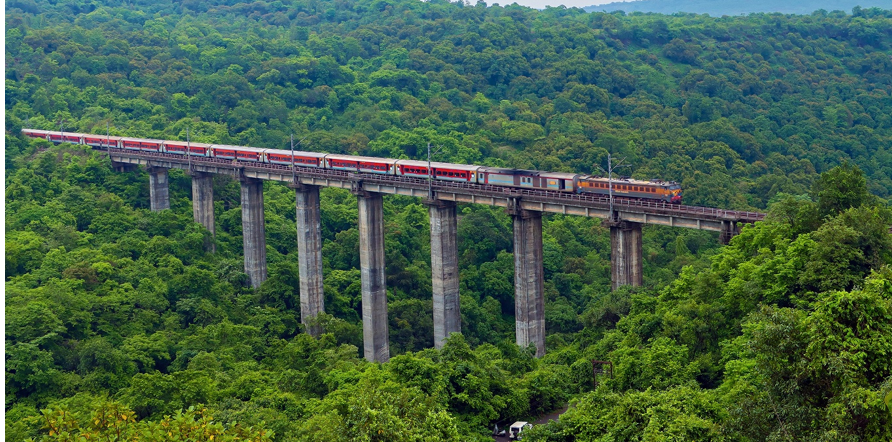
Thirty-five years ago, a bold vision began to take shape along India’s rugged western coastline—one that many believed was unattainable. Building a railway through dense forests, steep mountains, deep valleys, and one of the world’s heaviest rainfall regions demanded exceptional engineering skill and unwavering resolve. Today, the 740-kilometre Konkan Railway stands as a landmark achievement in nation-building, seamlessly linking Mumbai with Mangaluru and connecting the coastal districts of Maharashtra, Goa, and Karnataka to the national rail network.
By dramatically reducing travel time and improving reliability, the railway transformed a once-isolated region into a vibrant economic corridor. Agriculture, fisheries, tourism, and port-led industries have all benefited from faster market access and lower logistics costs. Konkan Railway has not only enhanced mobility but also catalysed inclusive growth, employment, and regional prosperity—proving how visionary infrastructure can redefine geography and unlock long-term development.
More Than a Ride: Transforming the Way We Travel
Konkan Railway is steadily reshaping the idea of rail travel along India’s western coast—quietly, thoughtfully, and with a clear focus on the passenger. What is emerging across its network is not just better infrastructure, but stations that feel more welcoming, more contemporary, and far more attuned to the needs of modern travellers.
Comfort has been a central theme of this transformation. Executive lounges are already operational at stations such as Khed, Chiplun, Ratnagiri, Thivim, Madgaon, Mookambika Road, Byndoor and Udupi, offering passengers calm, well-appointed spaces to relax before their journey. The network is set to expand further, with new lounges planned at Mangaon, Kankavali, Kudal, Sawantwadi Road and Karmali.
Madgaon station, one of the busiest on the route, reflects this new approach most visibly. A recently commissioned foot overbridge now connects all platforms seamlessly and is equipped with lifts, significantly improving ease of movement for senior citizens, persons with reduced mobility and families. The station has also added a modern Rail Arcade with multiple branded food outlets, giving passengers access to hygienic and diverse dining options. Similar arcades are in the pipeline at Surathkal and Ratnagiri.
Food, leisure and family-friendly spaces have received special attention. The speciality restaurant Anandam at Thivim, the Coach Restaurant at Madgaon, and food plazas at Madgaon and Kudal have quickly become popular—not only with passengers, but also with local residents. Adding a lighter, more personal touch, a dedicated Kids’ Play Area at Platform 1 of Madgaon station allows young travellers to unwind before boarding.
Safety and inclusivity remain integral to these efforts. Women-only waiting areas, branded as “Pink Bubble”, have been created at Madgaon, Murudeshwar and Bhatkal, offering a secure and comfortable environment. To enhance the overall station experience—particularly for tourists—affordable garment shops have been introduced at Madgaon, Thivim and Udupi, while Relax Zones with massage chairs are available at Madgaon, Thivim and Karmali.
Special facilities for senior citizens and Divyang passengers, including battery-operated cart services at Madgaon, further underline the passenger-first philosophy. Digital services are also being strengthened, with DigiLocker facilities already operational at Thivim and Udupi, and proposed at several other stations across the route.
Looking ahead, transit lounges with resting and Bed & Breakfast facilities are planned at Madgaon, Thivim, Mookambika Road, Byndoor and Udupi—particularly aimed at passengers with long layovers or early-morning connections.
Parallel to these initiatives, core infrastructure upgrades are progressing steadily. High-level platforms are under construction at Kumta, Gokarna, Mulki and Goregaon, while platform extensions are underway at Bhatkal, Padubidri and Mangaon. Lift facilities are being added at Udupi, Thivim, Sawantwadi Road and Mangaon, new foot overbridges are coming up at Gokarna, and modern toilet blocks are being built at Murudeshwar and Udupi. Station façade beautification, undertaken in collaboration with the Maharashtra PWD, has already been completed at several locations across Maharashtra.
All the passenger amenities mentioned above were developed without any expenditure by Konkan Railway, through the conceptualisation and implementation of a revenue-based model on the lines of the BOT framework. Over the next three years, passenger amenity works worth approximately ₹105 crore are planned across multiple stations. Together, these initiatives reflect a long-term commitment by Konkan Railway Corporation Limited to elevate passenger experience.
Modernisation in Operations
During the Ganapati festival of 2025, Konkan Railway achieved a historic milestone by operating 376 Ganapati special trains—the highest number ever run during the festival period. Ganapati being the most cherished festival of the coastal regions of Maharashtra, these special services played a vital role in helping thousands of passengers travel comfortably and on time to their native places. Extending this commitment beyond the festive season, Konkan Railway has operated a total of 1,228 special trains in the current financial year, the highest ever, reaffirming its dedication to meeting passenger needs and ensuring smooth, reliable connectivity.
During FY 2025–26, Konkan Railway Corporation Limited has continued to demonstrate strong operational and sustainability-led performance. A total of 144 Crack Special Trains have been operated so far, leading to a saving of more than 150 crew sets and enhancing operational efficiency. Significant gains have also been achieved through electrification: against loans of about ₹1,250 crore availed for the project, nearly 80–90% of rail traffic has now shifted to electric traction, translating into annual fuel cost savings of approximately ₹200 crore. In the renewable energy domain, solar power plants of 350 kWp along with rooftop solar installations of 309 kWp have been commissioned at various stations, generating 48.42 lakh units of electricity and yielding energy bill savings of about ₹554 lakh. Further strengthening this green transition, work is underway on a 4 MWp solar power plant at Thivim, a 220 kWp plant at Madgaon, and a 101 kWp plant at Udupi, with plans to develop an additional 4 MWp solar power plant at Ratnagiri under the PPP model in the near future.
Momentum in Motion: The Freight Turnaround
On the freight front, Konkan Railway Corporation Limited (KRCL) has delivered a notably strong performance, handling 10.3 million tonnes of freight, of which 2.8 million tonnes constituted originating traffic. This momentum has been built steadily over the past few years through the addition of new and varied freight streams, underscoring a conscious shift towards a more diversified and sustainable cargo portfolio.
A major contributor to this growth has been the newly introduced bauxite traffic from Karanjadi, which alone generated around ₹93 crore in revenue through the movement of 173 rakes. Petroleum traffic from the HPCL Refinery at Mangaluru to Ellatur has added nearly ₹19 crore with 237 rakes, while fertilizer movement from Indapur contributed approximately ₹6 crore across 25 rakes. The transportation of laterite from Zarap, amounting to about 8,000 tonnes, along with fresh container traffic from Khed, Ratnagiri, and Verna, has together earned over ₹50 crore through the movement of nearly 175 rakes. More recently, containerised traffic carrying polypropylene has commenced from Thokur, further expanding the freight basket. In parallel, KRCL enhanced the carrying capacity of its Ro-Ro wagons from 50 tonnes to 57 tonnes—an upgrade executed entirely through in-house expertise and generating revenue of over ₹1 crore.
This robust freight performance is closely aligned with sustained investments in modern freight infrastructure along the Konkan corridor. New container rail terminals and warehouses have been developed at Indapur, Verna, Udupi, and Thokur, collectively offering close to 2.17 lakh square feet of storage space. Work is also progressing on a cold storage facility at Ratnagiri, the extension of the container siding at Balli, and the development of new freight terminals at Bhoke and Ankola under the PM Gati Shakti initiative.
Taken together, these initiatives are creating a solid platform for future growth—stimulating trade, strengthening the regional economy, generating employment, supporting tourism, and reaffirming Konkan Railway’s role as a critical logistics and connectivity backbone for the region.
Paradigm Shift through Strategic Projects
The Udhampur–Srinagar–Baramulla Rail Link (USBRL) project stands as a defining milestone in Konkan Railway’s journey, firmly establishing the organisation on the global infrastructure map. At the centre of this achievement are two engineering landmarks of international significance: the Chenab Bridge, the world’s highest steel arch railway bridge soaring 359 metres above the riverbed—higher than the Eiffel Tower—and the Anji Khad Bridge, India’s first cable-stayed railway bridge. Together, they reflect Konkan Railway’s capability to conceptualise and deliver projects of exceptional complexity and scale. The dedication of the USBRL project to the nation by the Hon’ble Prime Minister Shri Narendra Modi on 6 June 2025 marked a historic moment, finally realising the long-envisioned dream of uninterrupted rail connectivity from Kashmir to Kanyakumari.
Beyond USBRL, Konkan Railway’s project portfolio continues to expand steadily across sectors and geographies. The organisation is currently executing major bridge, tunnel, and viaduct works for new broad-gauge railway lines between Taranga Hill in Gujarat and Abu Road in Rajasthan, valued at ₹716 crore, and between Khurda Road and Bolangir in Odisha, valued at ₹377 crore. Its presence is equally strong in port-led infrastructure, including rail connectivity to Vizhinjam International Seaport, valued at ₹1,200 crore, and a new railway rake examination facility at Paradip Port, valued at ₹99 crore. We also have a presence in notable non-railway infrastructure projects, such as the Twin Tube Road Tunnel project in Kerala, valued at ₹2,300 crore; infrastructure and land development works for the National Maritime Museum in Gujarat, valued at ₹248 crore; and many more. In addition, Konkan Railway has set up a rolling stock component manufacturing facility at Lote near Chiplun for Central Railway, involving an investment of ₹402 crore.
What truly sets Konkan Railway Corporation Limited apart is its wide-ranging, multi-disciplinary expertise—spanning civil works, electrical systems, signalling and telecommunication, operations and maintenance, consultancy services, and several other specialised fields. With projects worth approximately ₹11,000 crore currently in hand, the organisation’s growth trajectory has been both rapid and consistent. Notably, having entered the electrification domain only four years ago, Konkan Railway has already emerged as a major player, executing electrification works across 16 zonal railways. It has also undertaken interior and allied electrical works for the Panvel Municipal Corporation and is currently executing the supply and installation of electrical systems for the Sivok–Rangpo new broad-gauge railway line in the challenging terrain of West Bengal and Sikkim. The combined value of these electrical works stands at around ₹8,500 crore.
The Konkan Railway line itself passes through some of the most demanding terrain in the country, receiving annual rainfall exceeding 3,500 mm. Operating and maintaining rail infrastructure under such extreme climatic conditions has become one of the organisation’s core strengths. Over 35 monsoons of hands-on operational experience have equipped Konkan Railway with deep technical and managerial insights, which it now shares with rail systems across India and abroad. A significant international milestone was the construction of Nepal’s first broad-gauge railway line, where the inaugural service—jointly flagged off by the Prime Ministers of India and Nepal—marked a transformative moment for rail travel in the country. Konkan Railway is also involved in metro rail construction projects in Congo, reinforcing its credentials as a trusted international infrastructure partner.
Today, Konkan Railway is widely recognised as a trusted name in the operations and maintenance of railways, metro systems, depots, and allied assets. It currently operates the Navi Mumbai Metro line and maintains rolling stock for Western Railway in the Vadodara and Bhavnagar divisions. The organisation is also developing state-of-the-art Vande Bharat maintenance facilities at Ajni (₹117 crore) and Wadi Bunder (₹104 crore). In addition, it is engaged in the supply and maintenance of locomotives for Mormugao Port Authority and Syama Prasad Mukherjee Port. Importantly, Konkan Railway has also been entrusted with the operations and maintenance of the prestigious USBRL project. In total, Konkan Railway is executing O&M projects valued at approximately Rs 1500 Cr..
This remarkable transformation has been driven by the creation of a dedicated Project Development and Monitoring Cell, which has strengthened planning, execution, and oversight. Building on this momentum, Konkan Railway is now aiming to secure projects worth ₹15,000 crore in the current financial year, reaffirming its ambition to grow further while delivering infrastructure that stands the test of time.
Transformation from Cost Centre to Profit Centre
Another significant aspect has been the optimisation of internal efficiencies. We have driven profitability through innovative approaches, successfully transforming traditionally cost-intensive functions—such as training and IT—into revenue-generating verticals. In most organisations, these departments remain cost centres, requiring continuous investment in employee development and IT infrastructure.
Backed by more than three and a half decades of rich operational experience, the organisation has systematically shared its knowledge with peer institutions, helping them adopt proven best practices. To date, over 2,000 students from engineering and management institutes have been trained, along with employees from various PSUs and peer organisations, taking the total number of trained professionals to more than 3,000. In addition, specialised training programmes in tunnelling and bridge engineering are being conducted, including overseas hands-on exposure in Switzerland and the United Kingdom. These initiatives have generated training revenues exceeding ₹9 crore.
In parallel, Konkan Railway has built a strong and resilient in-house IT ecosystem. Moving beyond dependence on external vendors, the organisation now provides end-to-end IT solutions—ranging from payroll management to accounting systems—to several PSUs. This strategic shift has not only strengthened internal capabilities but has also emerged as a significant revenue stream, contributing nearly ₹10 crore.
The organisation has undergone a comprehensive transformation across multiple dimensions, signalling a decisive shift towards modernisation, innovation, and sustainability. Passenger experience has been significantly elevated through the introduction of enhanced amenities such as executive lounges, rail arcades, restaurants, cafés, women-centric “Pink Bubble” facilities, façade beautification, and new foot overbridges—collectively creating a more comfortable, safe, and welcoming travel environment. At the same time, operational capabilities have been strengthened with the development of new freight loading facilities, state-of-the-art warehouses, and the steady expansion of containerised services.
In parallel, a strategic emphasis on project development led to the formation of a dedicated Project Development and Management Consultancy (PDMC) cell, enabling the organisation to successfully bid for and execute diverse infrastructure projects. These initiatives, supported by prudent financial management, have transformed the organisation into a profit-making entity. The cumulative impact of these efforts has significantly enhanced brand credibility, reflected in high credit ratings and growing recognition as a trusted infrastructure solutions provider.
So, what exactly has changed? The most significant shift has been in the psyche of Konkan Railway itself. From operating like a typical government setup in the past, the organisation has evolved into a professionally driven, corporate-style entity with a clear focus on performance and profitability.
Overall, the transformation journey of Konkan Railway Corporation Limited reflects a balanced and forward-looking approach that seamlessly integrates passenger-centric services, operational excellence, strong project execution capabilities, and robust brand positioning. This holistic evolution has established KRCL as a leading infrastructure solutions provider—not only across India, but also on the global stage.